
Comparative Analysis: 2 Cats Lost in the Desert
Then (2002) & Now (2025)

2002 Rollover Crash - No Assistance At All
Over the years, interest in lost pet recovery work has grown dramatically since I first started recovering lost pets. I recall a case that still haunts me to this day.
Back in 2002, I received a phone call from a professor in Arizona who begged me to fly my bloodhound to Phoenix to help her track her missing cats. She and her husband had been involved in a horrendous rollover car accident in the desert, during which her three cats were thrown from the car.
With her husband in critical condition in the hospital and the professor herself injured herself, she was in desperate need of someone who could offer her hands-on help at the crash site to recover her cats. Even though her cats were crated, their plastic carriers had broken open in the crash, and they ran terrified into the desert.
I could not travel to Arizona to help her. In those days, I turned down many requests to travel with my bloodhounds because I was in the process of building the training program that would train others to respond to recover lost pets in their own communities. I encouraged her to contact feral cat groups in the Phoenix area to see if someone, anyone, would be willing to humanely trap her three cats.
Even though using humane traps to recover lost cats was unheard of at that time, I knew that feral cat groups had the equipment and the trapping experience to be able to recover this woman’s cats. Sadly, not one of the groups she contacted was willing to respond and help her.
Tragically, her cats were never found.
2025 Rollover Crash - Charlie & Yesenia to the Rescue!
Contrast the 2002 Phoenix case with a crash that happened on January 9, 2025, in Las Vegas, Nevada. A motor home was struck head-on by a big rig. The family in the motorhome were injured and their two cats, Neko and Teto, escaped in a complete panic into the desert. The motorhome was completely destroyed and the pile of debris from the crash was transported to a tow yard located 45 minutes away.
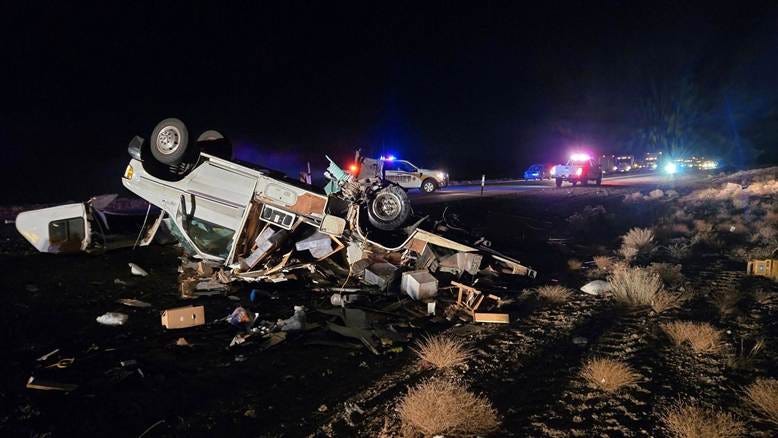
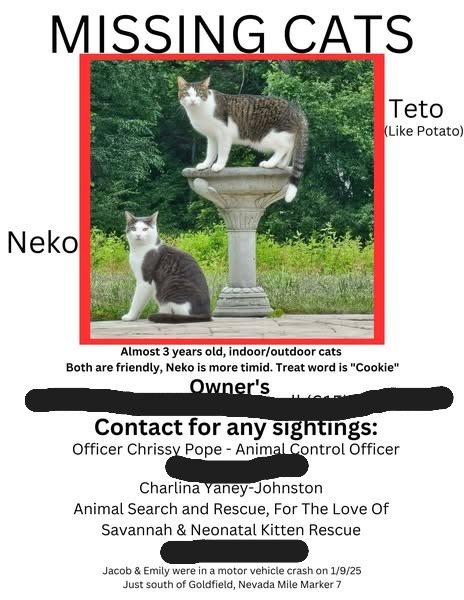
Many first responders on scene suspected that both of the cats “were probably dead,” but not volunteers from a very dedicated and determined rescue called For the Love of Savannah & Neonatal Kitten Rescue! Founder Charlie Yaney-Johnston and volunteer Yesenia jumped into action. Neither of these gals was trained through our MARN training program, but their tactics and techniques (and skills in building a kennel trap) were spot on! This tells us that although MARN has very few “MAR-trained” teams located on the West Coast, many volunteer teams (like Charlie’s) are actively out there recovering lost cats (and dogs).
Proper Recovery Gear and Strategies Used
We’ve seen many cases where cats involved in a traffic accident took refuge inside of the crashed vehicle, were transported in that vehicle to a tow/junk yard, and then took up residency at that tow yard or junkyard. The Neko-and-Teto team did the right thing by conducting dual searches. They set baited humane traps and surveillance cameras at both the crash site (in case the cats had fled into the desert after the crash) and at the tow yard where the remains of the RV were stored (in case the cats were there).
They combed the RV wreckage, but with proper, legal authorization, which is critical when a volunteer works a rescue like this. Charlie collaborated with the local Sheriff’s Office, Animal Control, Game Warden, Bureau of Land Management, and Nevada Department of Wildlife. They also limited the people allowed at the crash site to just four people: Charlie, her husband, Yesenia, and an Animal Control officer.
This type of “scene management” is also a crucial step in a high-profile case like this to prevent well-meaning rescuers from showing up and attempting to “catch” the dog or cat, only to scare them away, a problem that happens often due to people sharing sightings on social media.
In their initial search, Charlie and those with her did not find the Neko and Teto when they thoroughly searched the accident debris pile and inside the engine of the motor home. They set scent trails and used scented items that belonged to the cats’ owners at the feeding stations, which they monitored with cellular game cameras that texted real-time photos of the feeding stations to Charlie’s cell phone when triggered.
“People kept saying they were dead. But my tracking skills and experience told me otherwise. Yesenia and I scoured the desert for three days, stayed overnight in my SUV in freezing-cold weather, and looked for signs. That’s when we discovered their prints and scat at several culverts under the highway.”—Charlie
Once she discovered the prints and scat, Charlie set up scent trails that led back to the crash site, where she had built and placed a sophisticated kennel trap. It both provided protection from desert predators and contained a baited box trap, should the cats show up there. And her strategy paid off! Charlie began capturing photos of both Neko and Keto circling around the outside of the kennel trap.
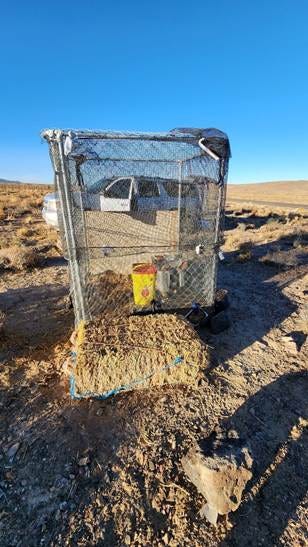
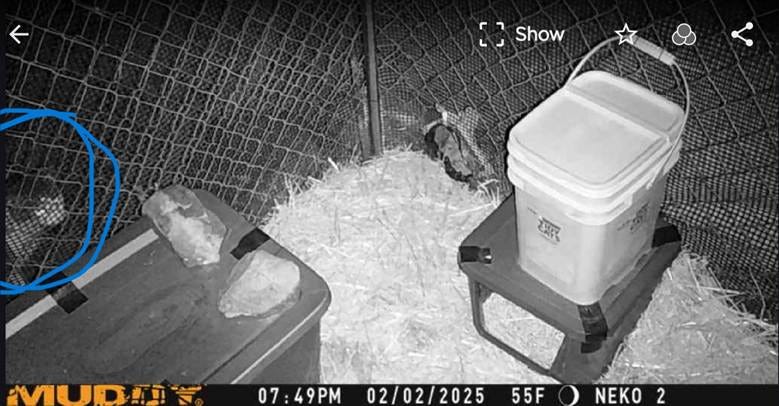
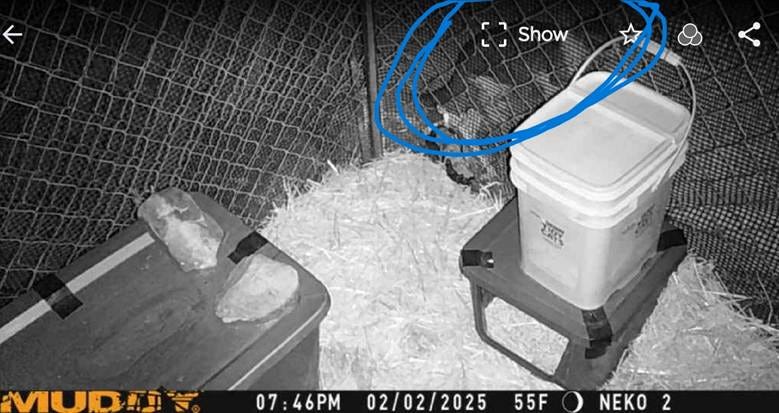
Successful Recovery!
Within a week—on her birthday, in fact—Charlie had humanely trapped Neko. But days passed, and Teto was still out there. A snowstorm was moving in, and the pressure to capture Teto was growing. Charlie had the owner of both cats sit outside wearing a snow suit, calling for Teto, while Neko was crated, meowing nonstop. Ultimately, Teto appeared, and after two attempts, the owner was able to grab, scruff, and capture Teto in his arms. The ordeal for both cats, their family, and Charlie’s team was finally over.
There were other volunteers who helped as well: the Animal Control Officer, Chrissy, who helped Charlie by connecting her to other government authorities and allowed Charlie to shower at her house; Yesenia, who monitored the cameras nonstop and kept Charlie updated; Jim and Annie from Silver Whiskers Animal Rescue, who allowed Charlie to shower at their home and were instrumental in helping recover a different cat involved in another car crash across town; and other volunteers who donated supplies and food.
I think that the most important lesson in this story is the hope and faith that Charlie held onto that she most certainly could be successful with this recovery.
“When everyone doubted me, it felt so good to finally show them that it is possible [to recover 2 cats lost in a coyote-filled desert] with the right skills, me pushing people, me researching to do things legally, knowing the people I know to get it done, and getting the right help that was needed.”—Charlie
When the family of Neko and Teto asked Charlie “How can we repay you?”, her response was, “Pay it forward. Take what you’ve learned from me and help others in Dorian like this whenever you can.”
It’s exciting to see that 23 years after my Phoenix phone consultation (with the professor who received no onsite trapping assistance), volunteers like Charlie, Yesenia, and others are taking the initiative to incorporate lost cat recovery services in their community. In fact, Charlie and her team have already used that same kennel trap to recover other displaced cats in their area.
This is what we mean by “community-based lost pet recovery services.” Sometimes, it takes a village to trap two cats!
Your stories are hopeful reminders that a community mindset paired with confidence in the face of doubt are 2 critical factors for hope.
fabulous dedication - true animal lovers with the ultimate reward for the owners to be able to sleep at night in peace