
K9 Pet Tracker Training 101
New class starts Wednesday January 7, 2026

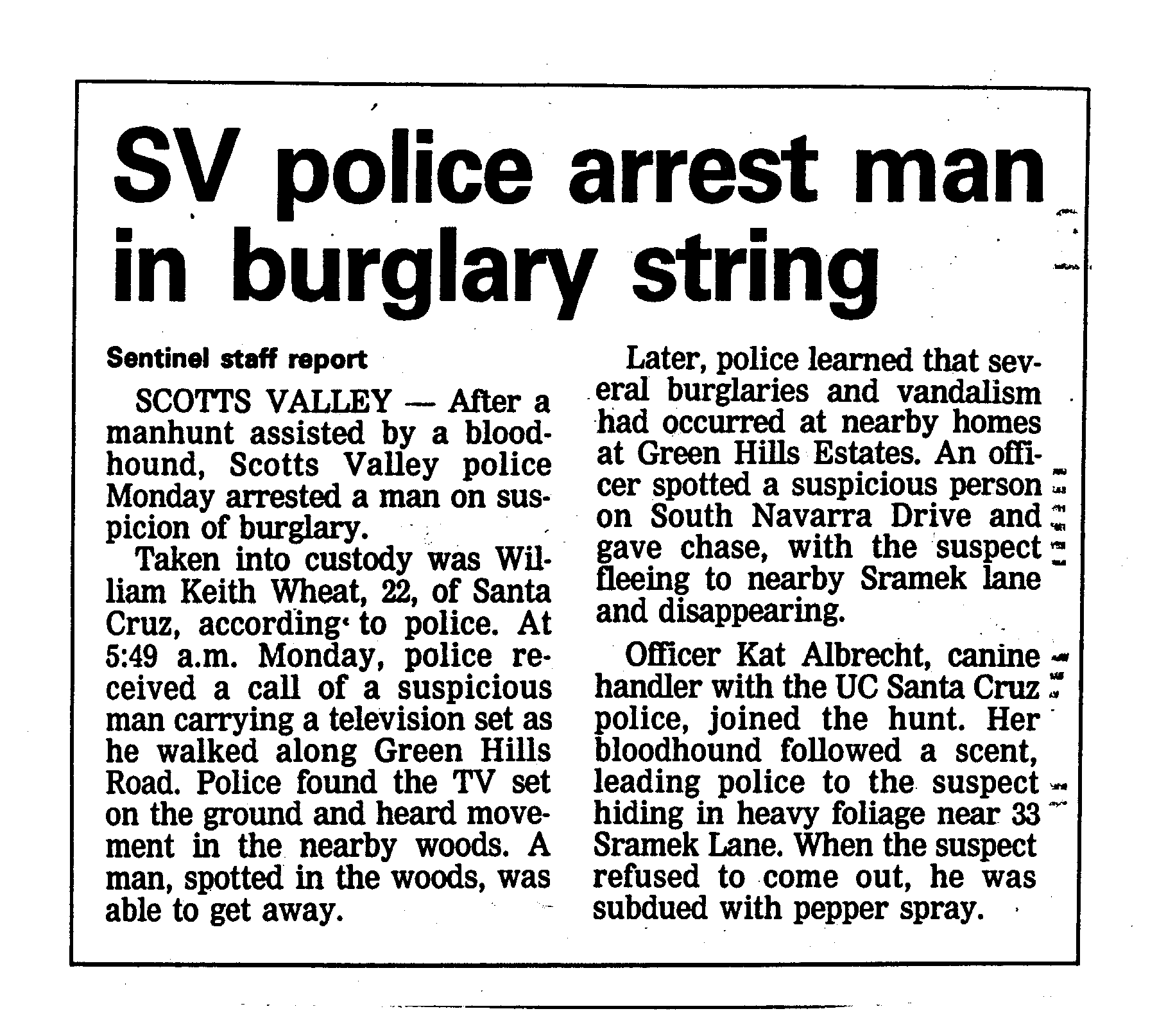
In this post, I pull back the curtain on training dogs to find lost pets. My knowledge in this area started back in 1989, when I trained my Weimaraner, Rachel, as a cadaver dog. Then, in 1991, I added police bloodhound training to my toolbox, aiming to become a sworn police bloodhound handler. I achieved that goal in 1993 when I was hired as a police officer (in Santa Cruz, California) and began using my bloodhound A.J. on missing-person and criminal cases. In his first search, A.J. had a “walk-up find” of an elderly Alzheimer’s patient. That success led to our being called out on many police investigations, like the one in the story below, which resulted in A.J. finding (and the officers capturing) a burglary suspect.
Then, in 1996, A.J. dug out from my yard and was lost in the redwoods. I used another search dog that successfully tracked him down. After that incident, I decided to “experiment” to see if I could train Rachel to track lost pets. I did, and we were very successful in recovering lost dogs and cats. My adventures in transitioning from police detective to pet detective are chronicled in my memoir Pet Tracker: The Amazing Story of Rachel the K-9 Pet Tracker, which you can find on Amazon, Audible, and even on my Substack home page (where it is serialized for free).
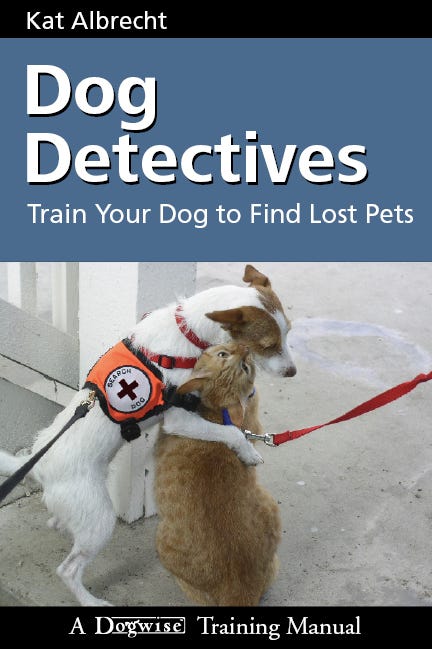
Fast forward to 2005, when I launched my second book, Dog Detectives: Train Your Dog to Find Lost Pets, which is still available as an e-book or paperback. However, it wasn’t until 2017 that I started offering online K-9 training. Through this program, my trainers have the dog handler set up a private Facebook group for their dog, video their dog as they complete the training exercises that we assign them weekly, and upload those videos and post them in their dog’s Facebook group. My trainers then review those videos, provides feedback, and assigns new homework that helps advance the team to work more difficult exercises over time.
In our training program, we train “MAR Trailing” dogs, which are dogs trained to follow only one specific scent and ignore all other scents. (MAR stands for “Missing Animal Rescue.”) MAR Trailing dogs are mostly used to track lost dogs, but they can be used to track other animal scents like lost cats, horses, or goats. The best dogs for MAR Trailing work are dogs that love other dogs and that get excited when another dog takes off and hides from them in a hide-and-seek game during the initial stages of training. They should have no aggression toward humans, dogs, or cats, and no major fear issues. At a cost of $750.00 for a 10-week class, it typically takes 6 of these classes (60 weeks of instruction) to train a MAR Trailing dog to be ready for certification.
Here’s a video of one of our students from Minnesota, Miki Carlson, and her dog, Scout, who’ve been training with us for 16 months (since Aug 2024). This video is of Miki working Scout on her first “blind” trail, meaning that Miki only saw the target dog vanish around the corner but had no clue where they went from there. Miki did a great job trusting Scout, who followed the scent trail and found the hidden target dog with no problem. We look forward to certifying this team soon and setting them loose to track lost dogs in their community. Yay!
We also train “MAR Cat Detection” dogs, which are dogs that are trained to alert to the scent of cat scent. These dogs are worked similarly to other detection dogs (drug, bomb, termite, etc.) in that the handler tells the dog where to search, and the dog will “alert” with obvious body language if and when they find the target (cat) scent. The best dogs for MAR Cat Detection work are dogs that go crazy when they see (or smell) a cat. We want a dog that wants to “get the kitty” but not “GET the kitty!” At a cost of $750.00 for a 10-week class, it typically takes just 1 or 2 (between 3 to 5 months) to train a MAR Cat Detection dog to be ready for certification.
The key, however, is to also have a laidback cat that has no fear of dogs and can be trained to crate quietly. Yes, it is possible to train a “target cat” to lay silently as a dog snuffles around in the woods, searching for the cat’s scent.
Here’s a video of my (dearly departed) target cat, Cheeto, as he patiently waited to be found by 4 MAR Cat Detection dogs during a 2011 training session.
If you have any interest in training a dog in this much-needed career, message me. Our next group 10-week MAR K9 class will start on Wednesday, January 7, 2026. That group will meet every Wednesday for 10 weeks, and we currently have 3 spaces open. You can learn more (and secure your space in that class) by going to this page and registering for the class.