

I have to be honest here—I’ve held off sharing this “part 2” of this “Pet Detective in the Papers” story because it has yet another sad ending and comes on the heels of the 2-part EXTRA TV sad story of our finding a missing cat named Cali. But it’s important to remember that not all lost pet recoveries have a happy ending. That is one of the primary reasons why I had many, many production companies pitch a reality pet detective series to Animal Planet only to have them all rejected. We can never guarantee that we will find a missing pet or that we can find them ALIVE, and Hollywood wants LIVE, HAPPY ending stories.
Next week, I will be taking a short break from the PET TRACKER memoir to share some exciting, HAPPY news about the pet memorial site that God is calling me to build. It will be epic, it will be amazing, and it will minister hope and healing to MANY OF US who deeply love and miss our companion animals. I hope that you’ll join me with an open mind and heart and see if this first-of-its-kind site will be a place where YOU will ultimately want to memorialize YOUR beloved but gone companion animal family!
I picked up a copy of the San Jose Mercury News and scanned the “lost cat” classified ads. I reached a couple of voicemails but couldn’t bring myself to leave a message. I figured if I left a message saying I was a pet detective, people would assume it was a prank. On the third call, a woman answered the phone.
“Hello, ma’am,” I said with as much professionalism as I could muster. “My name is Kat Albrecht. I’m a police officer with eight years of experience in training dogs to look for missing people. I recently trained one of my dogs to track missing pets.”
The woman was silent. I wondered if she thought I was a nut.
“I saw your ad in the paper about your lost cat,” I continued, “and my dog Rachel has already located a few missing cats. I normally charge a fee to conduct a search for a missing pet, but I have a newspaper reporter from the Chronicle who wants to come along and watch my dog work. I’m willing to come out and search for your cat for free.”
The woman was still silent. I began to feel foolish; my confidence waned.
“I know this all sounds really unusual,” I said apologetically, not sure what to make of her continued silence. “We really don’t need to do this if you’re not comfortable with it.”
“No, no,” the woman said, her voice sounding choked with emotion. “That’s not it. This has been a really rough month. My 19-year-old son died three weeks ago. His cat, Gizmo, disappeared the day before he died. Gizmo is the only part of my son that I have left. I really need to find this cat.”
I was stunned. Anyone who pays for a lost-cat ad could be expected to take the loss seriously, but I couldn’t have anticipated the gravity of the situation. The woman, Janet Leverich, gave me directions to her home in Saratoga, a small community west of San Jose.
I made arrangements with Andreas to meet me at Janet's house the following morning. It was raining steadily as I drove from Santa Cruz to Saratoga, which was located forty minutes from my home. Andreas arrived within a few minutes, and after a brief greeting, I knocked on the front door.
The article that Andreas wrote ultimately led to even more media attention, including an appearance in the popular tabloid THE EXAMINER. Boy, my family was sure proud when I made it to the gossip tabloids!
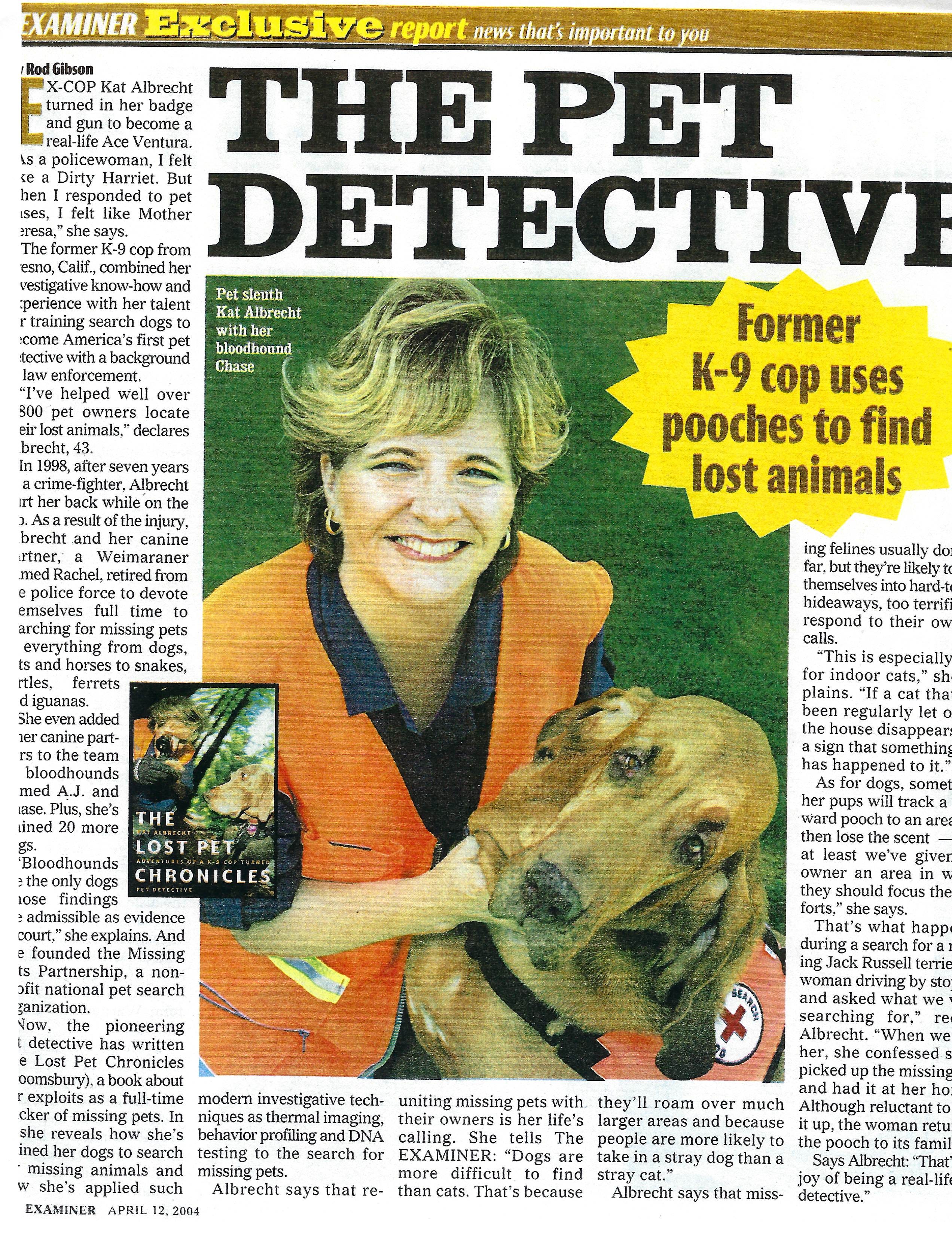
Janet invited us in. She and her husband, Lyle, showed us pictures of their son Doug and Gizmo, a gray tabby cat. They avoided talking about the death of their son and focused on the disappearance of Gizmo. The grief of both losses was evident in their voices and in their eyes.
“This cat means so much to us,” Janet told me. “My son loved Gizmo. We wonder if Gizmo might even have left because he sensed my son was so ill.”
A cat that looked like Gizmo had been spotted at a park a half mile down the road. Janet had been told that an unknown family with a small child had picked up the friendly cat and had taken it, presumably home with them. The cat was a gray tabby, just like Gizmo.
“Maybe your dog will take us to the park,” Janet said. I could hear the hope in her voice—hope that Rachel would help us determine that Gizmo was the cat from the park, hope that Gizmo was alive and well and self-adopted by a loving family with a child.
“Maybe,” I said. “We’ll give Rachel Gizmo’s scent and see where she leads us.” I didn’t want to be too optimistic. It seemed to me that a half mile was just too far for most cats to wander on their own. Andreas, the reporter, watched and listened in silence as I conducted my investigation. I determined where Gizmo spent most of his time and the exact area of his established territory. I learned that Gizmo slept on a pile of drapes, and I used that as my scent article. Gizmo had been missing for three weeks, and although his scent trail would be too weak to work, I could still use Rachel in an area-search mode to check the high-probability areas within Gizmo’s territory.
The rain peppered my jacket as I harnessed Rachel, presented Gizmo’s scent under her nose, and gave the search command. In spite of her dislike for the rain, Rachel worked with eagerness. For over an hour, we scoured the area. We checked the front and back yards in the neighborhood and a vacant field behind Gizmo’s home. We searched just about everywhere, except the house next door. Those particular neighbors had not been home for Janet to obtain permission for us to enter their property.
“Maybe we could go by and knock on the door. They might be home by now,” I suggested. It was the last area to search. Janet and Lyle knocked on the door while Andreas and I waited with Rachel on the front lawn. The neighbor came to the door and said it was fine for us to check her yard. I gave Rachel the search command, and we started to work past a group of heavy shrubs in the front yard. Suddenly, Rachel turned her head as she picked up an airborne scent. She pulled me toward the edge of a large bush. There, partially concealed, was the cold, wet, and decomposing body of a gray tabby cat. The cat was wearing a blue collar.
“Oh no,” I said as I came to an abrupt stop. No one else had seen the cat yet, including Janet, who was right behind me. “Was Gizmo wearing a blue collar?”
“Yes, why?” Janet said with urgency, rushing up to see what I had found. The cat was Gizmo.
Janet let out an agonizing wail, the kind of cry I had heard before at accidents and major crime scenes when a family member first learned that a loved one had died. Janet collapsed against her husband. Andreas stood back and watched in silence as I tried to examine Gizmo’s body for any indication of what could have killed him. I couldn’t see anything obvious, but it could have been anything, including accidental poisoning, being struck by a car, or an internal problem like an infection, a blocked urethra (a common condition that quickly kills cats called Feline Lower Urinary Tract Disease, or FLUTD), or any such medical condition.
“Can you tell how long he’s been dead?” Janet finally asked me.
“No,” I replied. “I’m sorry, but I really can’t.” The cold, damp winter conditions had preserved Gizmo’s body, but my hunch was that he had probably been dead since the day he failed to come home. Lyle helped Janet to her feet and began walking her back toward their house. A few moments later, he returned to me, alone.
“I am so very sorry,” I told Lyle. “Please tell Janet that I will be praying for her.”
“I will,” he answered. “Thank you for your help.”
In most cases, when we found a deceased pet, the owner was thankful for the closure. Gizmo was the first case I worked where finding the body of a deceased pet only seemed to magnify the family’s pain. I wished I could have left Janet and Lyle with their belief that Gizmo was still alive. For the first time, I wished a search had been a bust. It would have been better not to have found this missing cat at all. I was filled with remorse, guilt-ridden for adding to the couple’s grief.
Andreas offered to buy me lunch at a nearby restaurant so that he could complete his interview with me. We walked into the restaurant in silence. I sat down wearily in the booth. Andreas just looked at me. The waiter brought our waters and, after gathering my thoughts and controlling my emotions, I broke the silence.
“I’m sure you were planning to write a cute, Ace Ventura-type story for the paper,” I said. “But you can see that there’s a very serious side to this work. The people I help deeply love their pets. Their grief is not very different from the grief of losing a family member. People who don’t love animals may find this hard to understand.”
“To be honest,” Andreas told me. “My assignment was to write a lighthearted article. But I don’t think I can do that now. I’ll talk to my editor and see what I can do.”
Andreas kept his promise. Three days later, I opened the Chronicle and read an article titled “Cop Tracks Missing Pets in Off Time.” It was fair, truthful, and it didn’t gloss over the sometimes-somber realities of my lost pet searches. I was deeply grateful to the reporter for taking me seriously and for not treating my efforts like a joke.
It felt good to be respected.
I find it strange how Hollywood wants pet stories to end with rainbows and puppy dog tails, yet every other movie is about human loss or violence. My years with pets and people has led me to wonder if we have a stronger bond with our pets and therefore less tolerant of loss. Thoughts?